
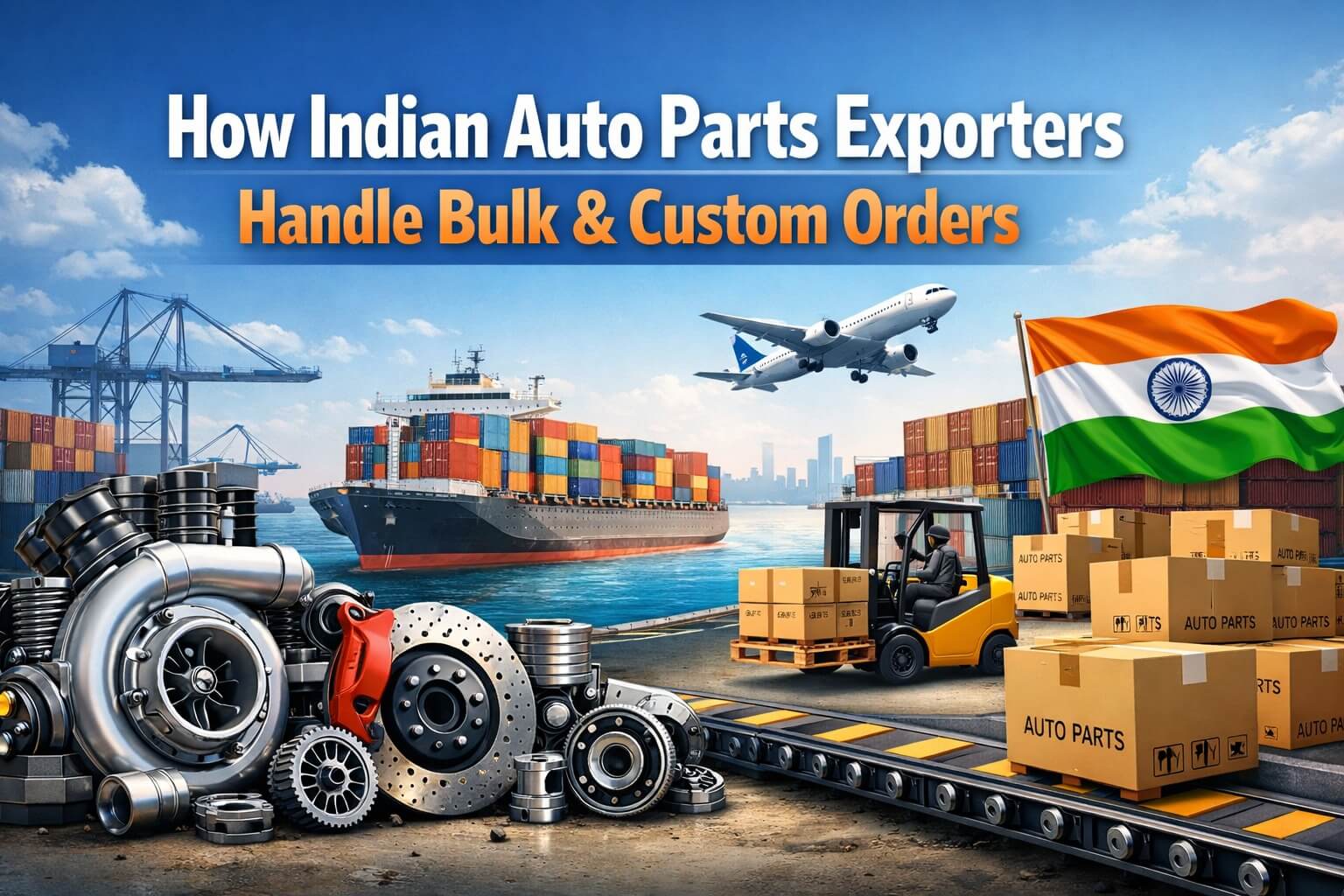
How Indian Auto Parts Exporters Handle Bulk & Custom Orders

Global automotive markets depend heavily on reliable supply chains, consistent quality, and the ability to scale quickly. As demand grows across OEMs, distributors, and aftermarket suppliers, Indian manufacturers have become a preferred sourcing destination. Understanding how Indian exporters efficiently manage auto parts bulk order requirements while offering customization helps international buyers make confident sourcing decisions.

This article explains the systems, processes, and strategies that make Indian auto parts exporters leaders in bulk and customized manufacturing.

Why Bulk & Custom Orders Matter in Auto Parts Export

In today’s competitive automotive industry, buyers often require large volumes delivered on strict timelines, along with region-specific or brand-specific customization. Whether it is engine components, suspension systems, or EV parts, exporters must balance scale with precision.

Indian exporters have mastered this balance by combining advanced manufacturing with flexible production models. This capability has directly contributed to the rapid growth of Auto Parts Export from India in global markets.

Strong Manufacturing Infrastructure Enables Bulk Production

One of the biggest strengths of India’s auto parts export lies in its large-scale manufacturing ecosystem. India hosts thousands of auto component manufacturers equipped with CNC machining, robotics, die casting, forging, and injection molding technologies.

Key infrastructure advantages include:

  • High-capacity production lines
  • Automated quality inspection systems
  • Cluster-based manufacturing hubs
  • Reliable raw material sourcing

These factors allow auto spare parts exporters in India to fulfill large-volume orders efficiently without compromising quality or delivery schedules.

Strategic Production Planning for Auto Parts Bulk Buy

Handling auto parts bulk buy orders requires precise planning and coordination. Indian exporters rely on advanced ERP systems to manage production schedules, inventory levels, and logistics.

Typical bulk-order workflow includes:

  • Demand forecasting and capacity allocation
  • Raw material procurement planning
  • Batch-wise production scheduling
  • Pre-dispatch quality inspections

This structured approach enables exporters to reduce lead times and maintain consistency across large shipments.

Customization Capabilities for Global Markets

Customization is a key differentiator for Automobile Spare Parts Exports from India. Exporters regularly tailor products based on:

  • Country-specific regulations
  • OEM technical drawings
  • Branding and private labeling
  • Packaging and palletization standards

Whether it’s a change in material grade, dimensions, coatings, or packaging, Indian exporters maintain dedicated customization teams to meet buyer requirements.

Contact Us Today

Send Your Bulk or Custom Requirement

Quality Control at Scale

Managing quality across bulk production is one of the biggest challenges in automotive exports. Automotive Spare Parts Exporters from India address this through multi-level quality assurance systems.

Quality control processes typically include:

  • Incoming raw material inspection
  • In-process quality checks
  • Dimensional and functional testing
  • Final batch inspection and documentation

Many exporters also offer third-party inspections to meet international buyer compliance requirements.

Supply Chain & Logistics Management

Efficient logistics play a crucial role in auto spare parts export from India, especially for bulk orders. Indian exporters coordinate closely with freight forwarders, ports, and customs authorities to ensure smooth dispatch.

Logistics best practices include:

  • Optimized container loading
  • Export-grade packaging
  • Accurate HS code classification
  • Documentation readiness

This reduces transit risks and ensures timely delivery across continents.

Cost Optimization Without Compromising Quality

One reason global buyers prefer India for bulk sourcing is cost efficiency. Exporters achieve this through:

  • Economies of scale
  • Optimized labor utilization
  • Lean manufacturing practices
  • Strategic supplier partnerships

These advantages make auto parts bulk order sourcing from India both economical and reliable.

Flexibility in Minimum Order Quantities (MOQs)

Unlike many global suppliers, Indian exporters often offer flexible MOQs. This allows new buyers to test product quality before committing to larger volumes, while existing buyers can scale up easily as demand grows. Exporters such as Sunshine Export follow phased production and dispatch models that support both trial and high-volume orders.

Role of Technology & Digital Communication

Modern exporters use digital tools to manage bulk and custom orders effectively. These include:

  • CAD/CAM integration
  • Digital quality reporting
  • Real-time production updates
  • Online documentation sharing

This transparency builds long-term trust between buyers and exporters.

Long-Term Partnerships with Global Buyers

Handling bulk and custom orders is not just about manufacturing; it’s about relationships. Indian exporters focus on long-term collaboration, continuous improvement, and repeat business.

Companies like Sunshine Export invest in dedicated account management teams to understand buyer needs, forecast demand, and ensure seamless order execution.

FAQs – Bulk & Custom Auto Parts Orders from India

Q1. Can Indian exporters handle large-volume auto parts orders?
Yes, Indian exporters are equipped with high-capacity manufacturing facilities designed for bulk production.

Q2. Do Indian auto parts exporters offer customization?
Yes, exporters provide customization in design, material, packaging, and branding as per buyer requirements.

Q3. How is quality maintained in bulk auto parts production?
Through multi-level inspections, testing protocols, and international quality certifications.

Q4. Are Indian auto parts suitable for OEM and aftermarket use?
Yes, Indian exporters supply both OEM-grade and aftermarket components globally.

Q5. What industries benefit most from bulk auto parts sourcing from India?
OEMs, aftermarket distributors, fleet operators, and EV manufacturers benefit the most.
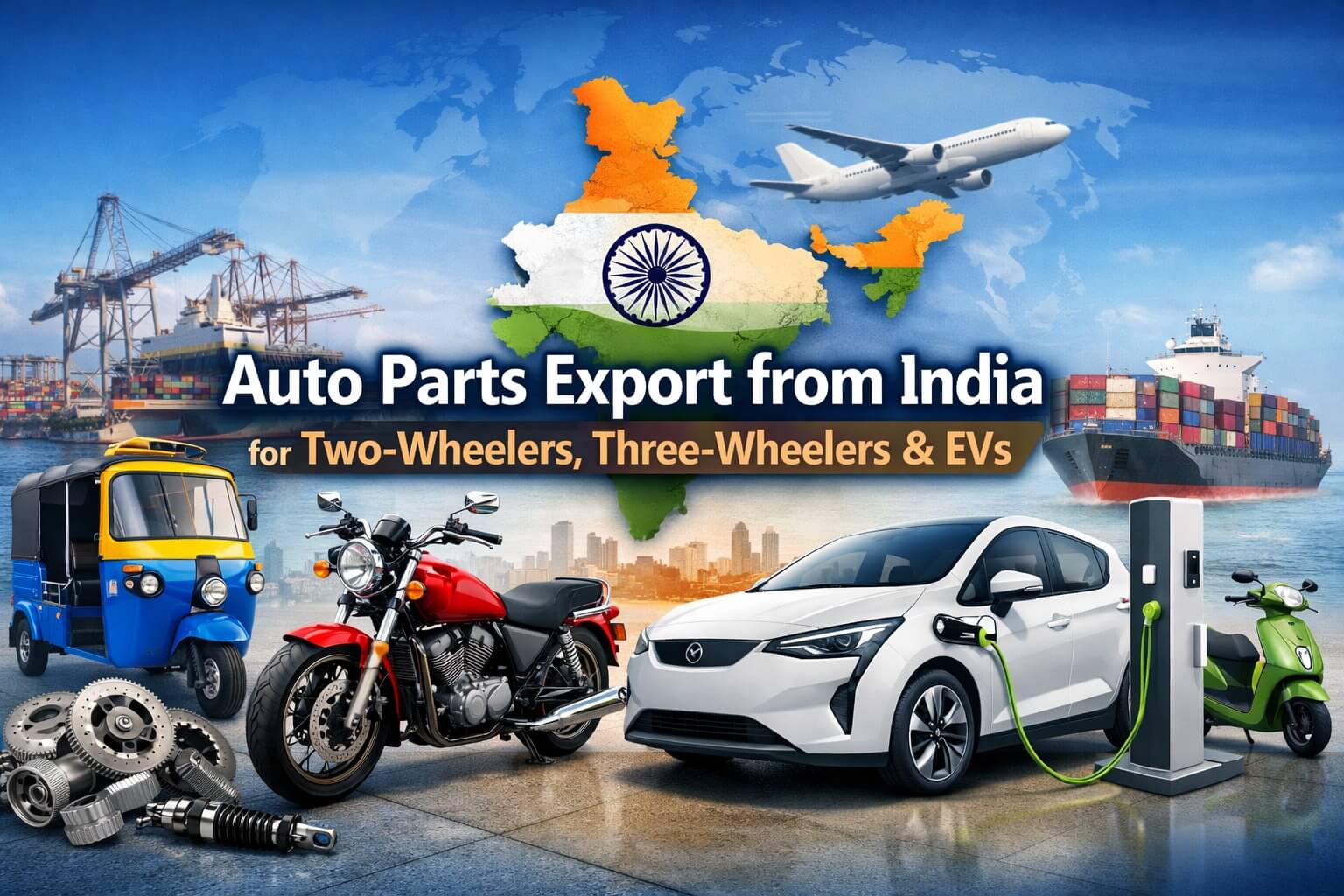
Auto Parts Export from India for Two-Wheelers, Three-Wheelers & EVs

India has emerged as one of the world’s most reliable manufacturing hubs for the automotive industry. With strong engineering capabilities, cost-efficient production, and strict quality standards, Auto Parts Export from India have witnessed rapid growth especially in the segments of two-wheelers, three-wheelers, and electric vehicles (EVs). Global buyers increasingly rely on Indian suppliers for consistent quality, competitive pricing, and scalable supply chains.

This blog explores why India is a preferred destination for automotive spare parts, what products are exported, what quality standards are followed, and what future opportunities exist in EV components.

Why India Is a Global Leader in Auto Parts Export

The growth of india auto parts exports is driven by several strategic advantages. India combines advanced manufacturing infrastructure with a skilled workforce, making it ideal for producing both OEM and aftermarket components. The country also benefits from a robust MSME ecosystem that supports bulk manufacturing and customization.

Key reasons global importers prefer India:

  • Competitive production and labor costs
  • Advanced CNC machining and automation
  • Strong R&D and product testing facilities
  • Compliance with international quality standards
  • Well-developed port and logistics infrastructure

These strengths make auto spare parts exporters in India highly competitive in global markets such as Africa, the Middle East, Europe, Southeast Asia, and Latin America.

Auto Parts Export from India for Two-Wheelers

India is the world’s largest producer of two-wheelers, making Two Wheeler Spare Parts Export from India a dominant segment. Indian exporters supply parts for motorcycles, scooters, and mopeds to both developing and developed markets.

Commonly exported two-wheeler components include:

  • Engine parts (pistons, valves, crankshafts)
  • Brake systems and suspension parts
  • Transmission components
  • Electrical and lighting systems
  • Body and plastic molded parts

Indian manufacturers support both OEM and aftermarket demand, offering customization based on international vehicle models and regional regulations.

Three-Wheeler Spare Parts Export from India

India is a global hub for three-wheeler manufacturing, particularly auto-rickshaws used for passenger and cargo transport. Three-wheeler spare parts export from India cater to high demand from Africa, South Asia, and the Middle East.

Key three-wheeler export components:

  • Engine assemblies and fuel systems
  • Chassis and suspension systems
  • Clutch plates and gearboxes
  • Steering and braking components
  • Electrical wiring and control units

The affordability and durability of Indian-made parts make them ideal for markets with demanding operating conditions.

EV Components: The Next Growth Engine

The shift toward electric mobility has opened new opportunities in Automobile Spare Parts Exports from India. Indian manufacturers are rapidly adapting to produce high-quality EV components for two-wheelers, three-wheelers, and electric cars.

Major EV parts exported from India include

  • Battery housings and enclosures
  • Motor components and controllers
  • Power electronics and wiring harnesses
  • Thermal management systems
  • Lightweight chassis and aluminum parts

Government incentives and increased investment in EV technology have positioned India as a future-ready supplier for global electric mobility.

Quality Standards & Certifications Followed by Indian Exporters

To succeed globally, Automotive Spare Parts Exporters from India strictly follow international quality and safety standards. Export-oriented manufacturers typically hold certifications such as

  • ISO 9001 (Quality Management)
  • IATF 16949 (Automotive Quality Standard)
  • ISO 14001 (Environmental Management)
  • RoHS & REACH compliance for regulated markets

These certifications ensure consistency, durability, and regulatory compliance for global buyers.

Contact Us Today

Request a Bulk Auto Parts Export Quote

Export Documentation & Compliance

A smooth auto spare parts export from India process requires proper documentation and compliance with international trade regulations. Exporters typically manage:

  • Commercial Invoice & Packing List
  • HS Code classification
  • Certificate of Origin
  • Bill of Lading / Airway Bill
  • Inspection and test reports

Experienced exporters also assist buyers with destination-country import regulations to minimize delays and risks.

Why Global Buyers Choose Indian Auto Parts Exporters

International importers increasingly rely on Indian suppliers because they offer:

  • Competitive pricing without compromising quality
  • High-volume production capability
  • Flexible MOQ options
  • Private labeling and custom packaging
  • Long-term supply reliability

Companies like Sunshine Export work closely with buyers to ensure consistent quality, transparent communication, and timely delivery across markets.

Future Outlook of Auto Parts Export from India

The future of Auto Parts Export from India looks extremely promising. With rising demand for EVs, increased global sourcing diversification, and continuous technology upgrades, Indian exporters are well-positioned for long-term growth.

Key trends shaping the future:

  • Rapid expansion of EV component exports
  • Increased demand for lightweight and sustainable materials
  • Digital quality control and smart manufacturing
  • Stronger trade partnerships with emerging economies

Export-focused companies such as Sunshine Export are aligning their strategies to meet evolving global automotive demands.

FAQs – Auto Parts Export from India

Q1. Why is India a preferred country for auto parts export?
India offers cost-effective manufacturing, skilled labor, global certifications, and reliable supply chains.

Q2. What types of auto parts are exported from India?
Engine parts, brake systems, suspension components, electrical parts, EV components, and body parts.

Q3. Are Indian auto parts suitable for international markets?
Yes, most exporters comply with ISO, IATF, and destination-country regulations.

Q4. Which regions import the most auto parts from India?
Africa, the Middle East, Europe, Southeast Asia, and Latin America.

Q5. Can Indian exporters handle bulk and customized orders?
Yes, many exporters support high-volume orders and private labeling.