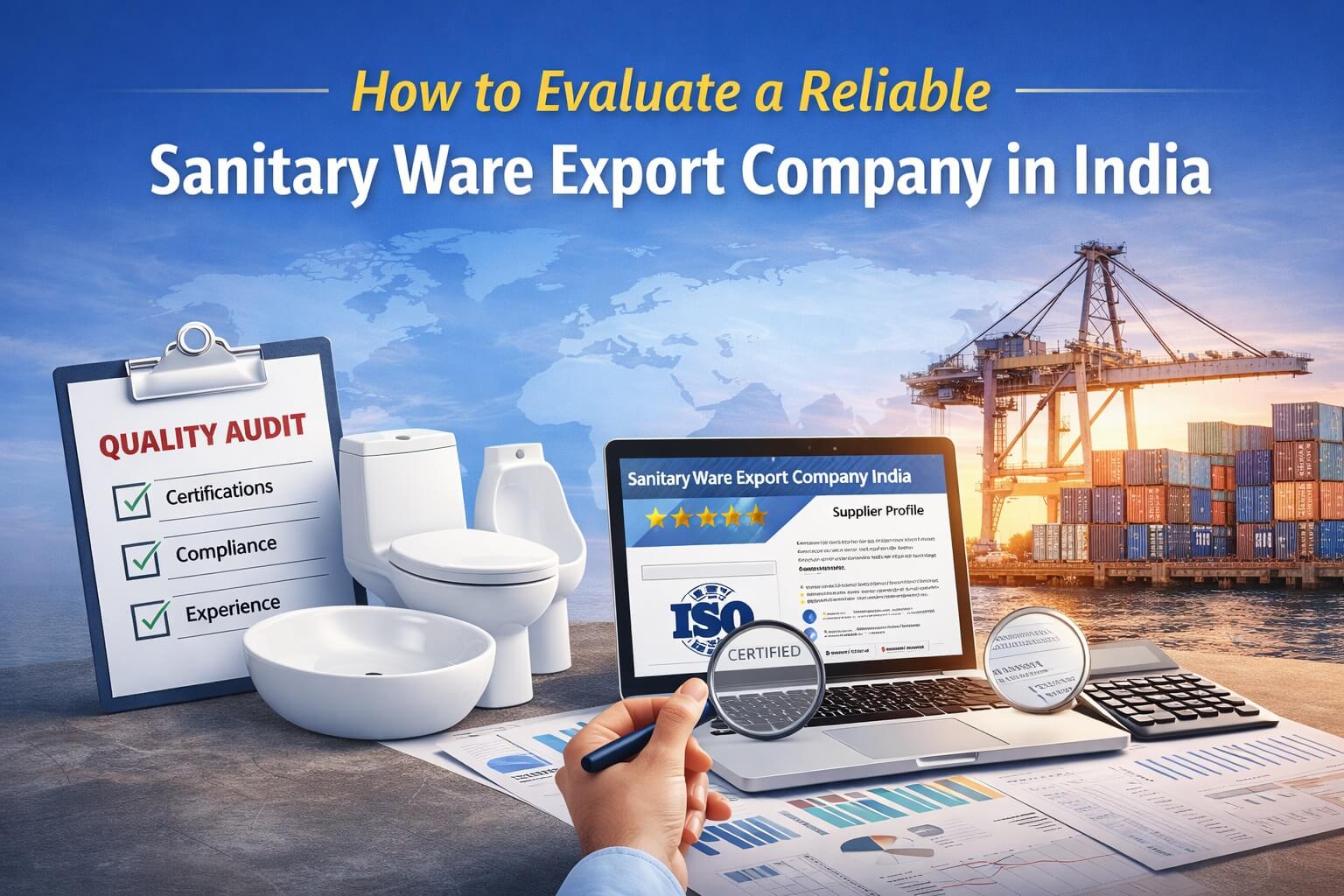
How to Evaluate a Reliable Sanitary Ware Export Company in India

India has become a preferred sourcing destination for global buyers looking for high-quality and cost-effective bathroom products. With strong manufacturing clusters, modern ceramic technology, and export-friendly infrastructure, sanitary ware export from India continues to grow across Africa, the Middle East, Europe, and Southeast Asia.

However, long-term success in international trade depends heavily on choosing the right supplier. Evaluating a sanitary ware exporter in India requires more than price comparison—it involves assessing quality systems, export experience, reliability, and scalability. This guide explains how importers can systematically evaluate a sanitary ware export company in India for sustainable, long-term partnerships.

1. Assess Manufacturing Capability & Infrastructure

A reliable exporter must have strong in-house manufacturing or direct control over production. Leading companies involved in bathroom sanitary ware export in India operate with:

  • Pressure casting technology
  • High-temperature tunnel or shuttle kilns
  • Automated glazing and finishing lines

Such infrastructure ensures consistency in design, durability, and output capacity, key factors for bulk sanitary ware exports from India.

2. Verify Product Range & Specialization

A professional sanitary ware export company in India should offer a comprehensive range, including:

  • Water closets (one-piece, two-piece, wall-hung)
  • Wash basins and pedestals
  • Urinals and accessories

Exporters who specialize in ceramic sanitary ware in India are better equipped to meet international quality and hygiene standards.

3. Evaluate Quality Control & Testing Standards

Quality assurance is critical when sourcing for overseas markets. Importers should verify whether the exporter follows:

  • Raw material inspection protocols
  • Water absorption and load-bearing tests
  • Surface glaze and crack resistance checks
  • Pre-shipment inspection procedures

Consistent testing ensures defect-free shipments and strengthens confidence in the export of sanitary ware from India.

4. Review Export Experience & Global Market Exposure

Experience in international trade significantly reduces risks. When evaluating a sanitary ware exporter in India, ask:

  • Which countries do they regularly export to
  • Whether they understand destination-specific regulations
  • How they manage export documentation and customs

Exporters with diverse market exposure are better positioned to support wholesale sanitary ware export from India without operational disruptions.

5. Analyze Packaging, Palletization & Breakage Control

Sanitary ware is fragile, making export packaging a critical evaluation factor. The best sanitary ware exporter in India ensures:

  • Multi-layer protective packaging
  • Foam cushioning and reinforced cartons
  • Heat-treated wooden pallets
  • Secure container stuffing methods

Effective packaging minimizes transit damage and improves landed cost efficiency for bulk sanitary ware export to India.

Contact Us Today

View the Export Company Evaluation Checklist

Reliable exporters maintain transparent pricing structures, including:

  • Clear product specifications
  • Defined Incoterms (FOB, CIF, CFR)
  • Payment milestones and delivery timelines

This transparency is essential for importers planning long-term sanitary ware export from India sourcing strategies.

7. Communication, Responsiveness & Documentation Support

Strong communication reflects operational maturity. A dependable exporter:

  • Responds promptly to inquiries
  • Shares production and shipment updates
  • Provides accurate invoices, packing lists, and certificates

Efficient coordination simplifies global trade and builds trust with a sanitary ware export company in India.

8. Scalability & Long-Term Supply Capability

For importers planning growth, scalability is essential. Reliable exporters can:

  • Handle repeat and high-volume orders
  • Maintain consistent quality across batches
  • Align production schedules with buyer forecasts

Companies like Sunshine Export focus on long-term collaboration by integrating production planning with importer demand, ensuring stability over time.

9. Ethical Practices, Compliance & Business Stability

Beyond product quality, importers should evaluate:

  • Legal registrations and export licenses
  • Ethical labor practices
  • Financial stability and business longevity

These factors reduce long-term risks when partnering for the export of sanitary ware from India.

10. Post-Shipment Support & Relationship Management

Long-term partnerships extend beyond shipment dispatch. A reliable exporter offers:

  • Shipment tracking assistance
  • Support in case of transit damage or documentation queries
  • Continuous improvement based on buyer feedback

Such support strengthens confidence in sanitary ware exports from India’s supply chains.

Frequently Asked Questions (FAQs)

Q1. Why is sanitary ware export from India growing globally?

India offers advanced ceramic technology, competitive pricing, and scalable manufacturing.

Q2. How do I identify the best sanitary ware exporter in India?

Evaluate manufacturing strength, quality control systems, export experience, and communication standards.

Q3. Can Indian exporters support bulk sanitary ware export orders from India?

Yes. Many exporters are equipped for large-volume and recurring bulk shipments.

Q4. Is a third-party inspection recommended?

Yes. Independent inspections add assurance before dispatch.

Q5. Do Indian exporters provide customized products?

Most exporters support private labeling and market-specific customization.
Step-by-Step Sanitary Ware Export Process from India for Global Importers

India has emerged as a trusted global sourcing hub for bathroom products due to its advanced ceramic manufacturing ecosystem, cost efficiency, and strong export infrastructure. As demand for premium and affordable bathroom solutions grows worldwide, sanitary ware export from India continues to expand across Africa, the Middle East, Europe, and Southeast Asia.

For global buyers, understanding the complete export workflow is critical to ensuring quality compliance, timely deliveries, and long-term supplier relationships. This guide explains the step-by-step sanitary ware export process from India, helping importers confidently source from a reliable sanitary ware exporter in India.

1. Understanding the Indian Sanitary Ware Export Industry

India is home to large ceramic clusters equipped with modern kilns, pressure casting technology, and automated glazing lines. These facilities support large-scale bathroom sanitary ware export operations in India, supplying products such as

  • Water closets (WC)
  • Washbasins
  • Urinals
  • Pedestals
  • One-piece and wall-hung systems

Established ceramic sanitary ware exporter India companies cater to both budget and premium global markets with consistent quality standards.

2. Selecting the Right Sanitary Ware Export Company in India

Choosing the right supplier is the foundation of a successful export partnership. When evaluating a sanitary ware export company in India, importers should consider:

  • Manufacturing capacity and certifications
  • Export experience and destination countries
  • Product range and customization capability
  • Packaging strength and breakage control
  • Communication and documentation support

Working with the best sanitary ware exporter in India significantly reduces risks related to quality inconsistency and shipment delays.

3. Product Selection & Customization

After finalizing the exporter, buyers select products based on:

  • Design and flushing technology
  • Size, dimensions, and glaze finish
  • Water efficiency and hygiene standards
  • Market-specific compliance requirements

Many exporters offering export sanitary ware from India also support private labeling, logo branding, and packaging customization for international distributors.

4. Pricing, Incoterms & Proforma Invoice

Once products are finalized, the exporter issues a Proforma Invoice (PI) outlining:

  • Product specifications and quantities
  • Unit pricing and total value
  • Incoterms (FOB, CIF, CFR)
  • Payment terms and production timeline

Clear commercial terms are essential for smooth wholesale sanitary ware export transactions from India.

5. Order Confirmation & Production Planning

After PI approval and advance payment, production begins. Reliable exporters manage:

  • Batch-wise production scheduling
  • Mold control and glaze consistency
  • In-process inspections

This stage ensures uniform quality for bulk sanitary ware exports from India, especially for large distributor orders.

6. Quality Control & Testing Process

Export-grade sanitary ware undergoes strict testing:

  • Dimensional accuracy checks
  • Water absorption testing
  • Glaze thickness and surface inspection
  • Load-bearing and crack-resistance tests

These procedures ensure durability and hygiene compliance for global sanitary ware exports from India markets.

Contact Us Today

See How Indian Exporters Handle Bulk Orders

7. Sorting, Grading & Final Inspection

Finished products are sorted based on:

  • Visual appearance
  • Weight and balance
  • Functional performance

Pre-shipment inspection ensures only export-approved goods are dispatched, strengthening trust in a professional sanitary ware exporter in India.

8. Export Packaging & Palletization

Sanitary ware requires robust packaging to prevent transit damage. Exporters ensure:

  • Multi-layer protective packing
  • Foam and corrugated cushioning
  • Heat-treated wooden pallets
  • Secure container stuffing

Proper packaging is critical to minimizing breakage during tile and sanitary ware export from India.

9. Documentation for Sanitary Ware Export from India

Key export documents include:

  • Commercial Invoice
  • Packing List
  • Bill of Lading
  • Certificate of Origin
  • HS Code declaration
  • Insurance (if applicable)

Accurate documentation ensures smooth customs clearance at origin and destination ports.

10. Shipping & Logistics Coordination

Exporters arrange:

  • FCL or LCL shipments
  • Sea freight bookings with reliable carriers
  • Shipment tracking and updates

Efficient logistics management is a hallmark of a dependable sanitary ware export company in India.

11. Delivery, Customs Clearance & Post-Shipment Support

After arrival, the importer handles customs clearance and inland transportation. Reputed exporters like Sunshine Export assist buyers with documentation support, shipment follow-ups, and repeat order planning to ensure long-term success.

Frequently Asked Questions (FAQs)

Q1. Why is sanitary ware export from India growing globally?

Due to competitive pricing, advanced ceramic technology, and consistent quality standards.

Q2. What products are commonly included in bathroom sanitary ware exports to India?

Water closets, basins, urinals, pedestals, and wall-hung systems.

Q3. Can I place a bulk sanitary ware export to India?

Yes. Most exporters support large-volume and recurring bulk orders.

Q4. Are Indian sanitary ware products compliant with global standards?

Yes. Sunshineexport is the leading ceramic sanitary ware exporter in India and follows international quality norms.

Q5. How long does shipping take?

Production takes 20–30 days, while shipping time depends on the destination country.

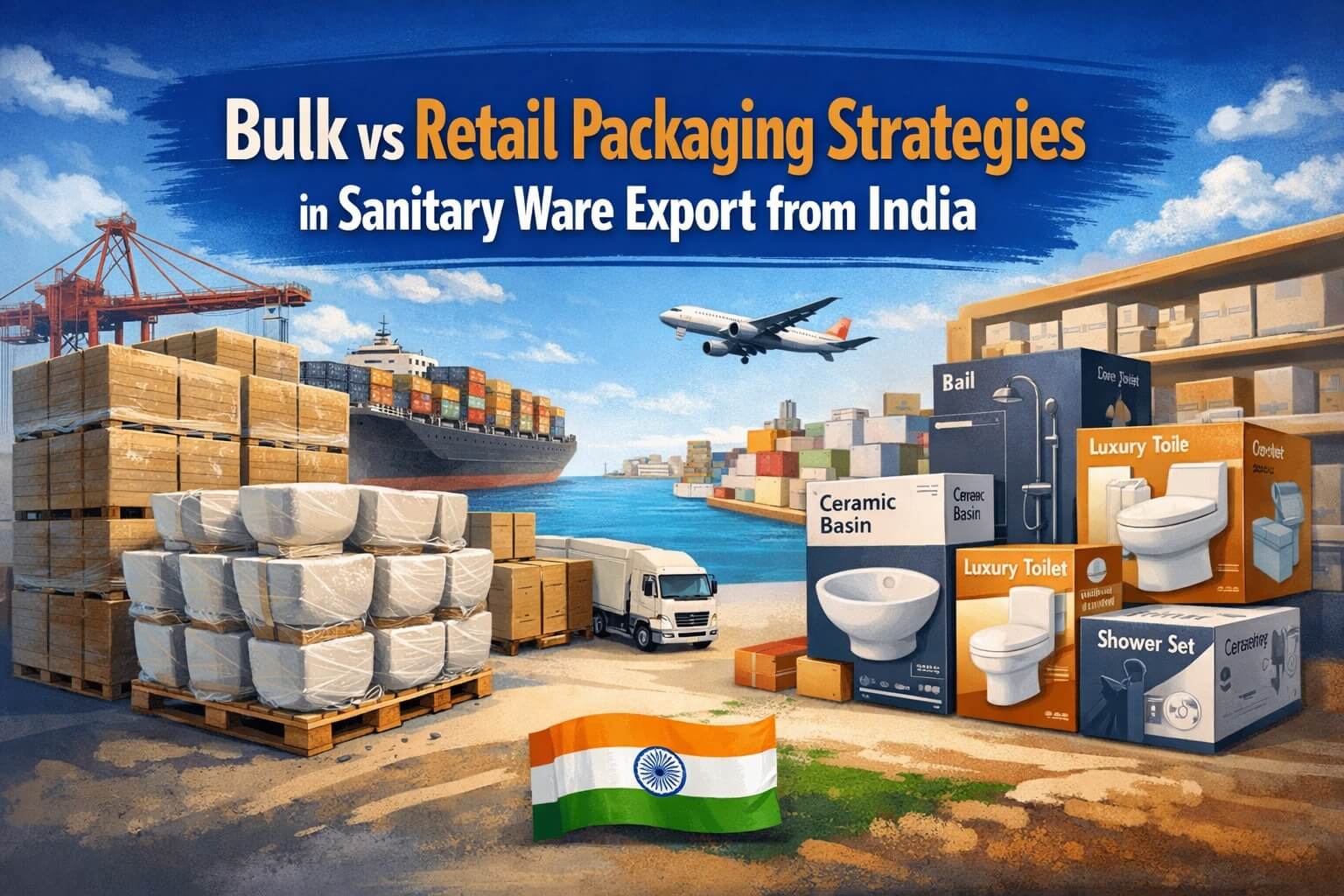
Bulk vs Retail Packaging Strategies in Sanitary Ware Export from India

Packaging plays a far bigger role in global trade than many importers initially realize, especially when dealing with fragile, high-value products like ceramic sanitary ware. In the competitive landscape of Sanitary Ware Export from India, choosing between bulk and retail packaging can significantly affect shipping safety, logistics costs, branding, and overall buyer satisfaction.

For international buyers involved in washhand basin toilet export from India, understanding the right packaging strategy is essential to minimize damage, optimize freight, and align with target markets. This guide explains the key differences, benefits, and decision factors behind bulk vs retail packaging in the sanitary ware export business.

Why Packaging Strategy Matters in Sanitary Ware Export

Ceramic products such as wash basins and toilets are heavy, fragile, and susceptible to damage during long-distance transportation. Improper packaging can lead to:

  • High breakage rates
  • Increased insurance claims
  • Delays in delivery
  • Loss of buyer trust

For exporters handling Ceramic Sanitary Ware Export from India, packaging is not just about protection—it is a strategic business decision that impacts profitability and brand reputation.

Understanding Sanitary Ware Export from India

India has emerged as a trusted global supplier of sanitary ware due to its advanced ceramic manufacturing capabilities, skilled workforce, and competitive pricing. Products commonly exported include:

  • Wash hand basins
  • Toilet bowls and WC units
  • Combined toilet and washbasin sets

With growing international demand for toilets and wash basins exported from India, exporters must meet varying expectations of wholesalers, retailers, contractors, and project developers across different regions.

What Is Bulk Packaging in Sanitary Ware Export?

Definition and Purpose of Bulk Packaging

Bulk packaging is designed for large-volume shipments, typically destined for wholesalers, distributors, or project-based buyers. It focuses on durability, space efficiency, and cost reduction rather than visual appeal. This approach is widely used for the washbasin for toilet export from India, where products are unpacked at warehouses before local distribution.

Materials Used in Bulk Packaging

  • Heavy-duty corrugated cartons
  • Molded pulp or foam separators
  • Wooden pallets or crates (for long sea transit)
  • Shrink wrapping and strapping

Benefits of Bulk Packaging

  • Lower packaging cost per unit
  • Better container utilization
  • Reduced overall shipment weight
  • Ideal for OEM and wholesale buyers

Bulk packaging is especially effective for toilet and hand basin export from India, where minimizing logistics costs is a priority.

What Is Retail Packaging in Sanitary Ware Export?

Definition and Purpose of Retail Packaging

Retail packaging is designed for direct display or resale. It combines strong protective elements with branding, product information, and visual presentation. Retail-ready packaging is commonly used in toilet and washhand basin exports from India aimed at showrooms and e-commerce platforms.

Retail Packaging Components

  • Printed branded cartons
  • Product images and specifications
  • Barcodes, SKU labels, and handling icons
  • Inner foam or protective inserts

Benefits of Retail Packaging

  • Strong brand visibility
  • Professional appearance for end customers
  • Easier handling at retail points
  • Better customer confidence

Retail packaging works well for toilet hand basin exports from India, where brand identity and presentation matter.

Bulk vs Retail Packaging: Key Differences

Cost Efficiency

Bulk packaging is more economical and suitable for large orders, while retail packaging involves higher material and printing costs but adds branding value.

Protection Level

Bulk packaging prioritizes industrial-grade protection for shipping. Retail packaging balances protection with aesthetics.

Buyer Type

  • Bulk packaging: Distributors, importers, contractors
  • Retail packaging: Retail chains, online sellers, and showrooms

Understanding your target buyer is crucial when exporting washhand basin toilet exports from India.

Contact Us Today

Get the Bulk vs Retail Packaging Checklist

How Packaging Impacts Logistics and Compliance

Freight Optimization

Well-designed bulk packaging allows better stacking, reducing unused space and lowering freight costs. This is critical in large-volume washbasin toilet exports from India.

Export Compliance

Proper packaging ensures compliance with:

  • Destination country labeling regulations
  • Fragile handling requirements
  • Moisture resistance for sea freight

Non-compliant packaging can lead to customs delays or shipment rejection.

Choosing the Right Packaging Strategy

Importers should evaluate:

  • Order quantity
  • Sales channel (retail vs wholesale)
  • Destination market expectations
  • Storage and handling infrastructure

Some exporters offer hybrid solutions with bulk packaging for transport and inner retail-ready cartons, providing flexibility for diverse markets. This adaptability is a key strength of Sunshineexport.

Key Selling Points of Indian Sanitary Ware Packaging

  • High protection standards for ceramic products
  • Cost-effective packaging solutions
  • Export-ready quality control
  • Flexible customization options
  • Expertise in Ceramic Sanitary Ware Export from India

Common Challenges and Solutions

Breakage During Transit
Solved with reinforced cartons, foam inserts, and drop-tested packaging.

High Freight Costs
Reduced through optimized carton sizing and palletization.

Branding Limitations
Addressed with customized retail packaging options.

Conclusion: Selecting the Right Packaging Strategy

Choosing between bulk and retail packaging is not a one-size-fits-all decision. The right approach depends on your market, order volume, and long-term business goals. For buyers involved in toilet and washbasin export from India, aligning packaging strategy with logistics efficiency and customer expectations ensures reduced risk, improved profitability, and sustainable growth.

What is the difference between bulk and retail packaging in sanitary ware export?
Bulk packaging focuses on cost efficiency and shipment safety for large-volume orders, while retail packaging combines protection with branding and presentation for direct resale.

FAQs – Bulk vs Retail Packaging in Sanitary Ware Export

What is the best packaging for exporting wash hand basins and toilets from India?
Bulk packaging is ideal for wholesalers and project buyers, whereas retail packaging is better suited for showrooms, retailers, and e-commerce sales.

Can bulk and retail packaging be combined in one shipment?
Yes, many exporters offer hybrid packaging solutions that combine bulk outer packaging with retail-ready inner cartons.

How is breakage prevented during ceramic sanitary ware export?
Breakage is minimized through reinforced cartons, foam or molded pulp inserts, proper palletization, and export-grade handling standards.

Is retail packaging suitable for toilet and wash basin export from India to e-commerce markets?
Yes, retail packaging is ideal for e-commerce, as it provides branding, product information, and enhanced protection for last-mile delivery.